
Understanding The Functional Differences Between Day Night Blinds And Standard Blinds
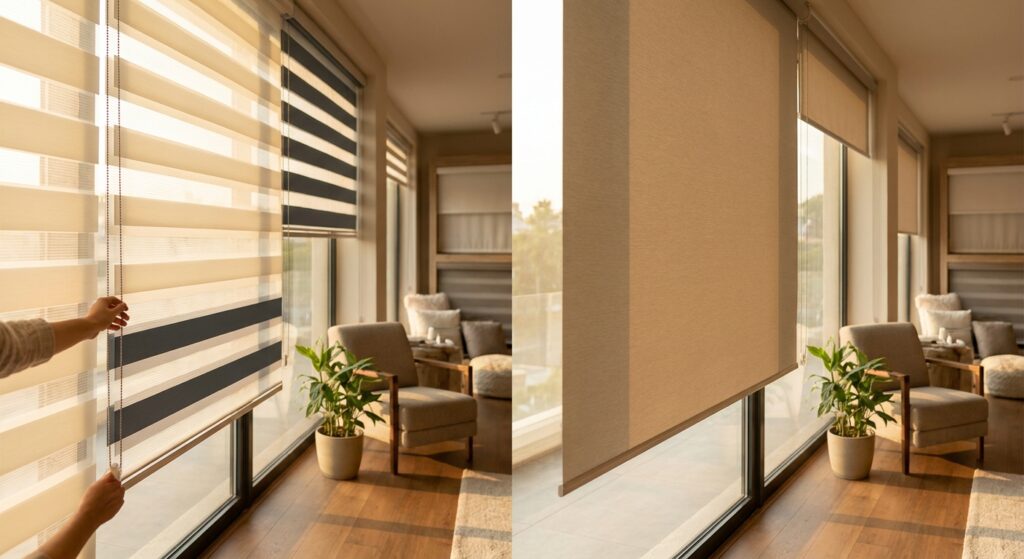
The primary difference between day/night blinds and standard blinds is their mechanical configuration: day/night blinds utilize a continuous loop of dual-layer fabric to toggle between light filtration and privacy, whereas standard blinds rely on a single-plane material to either cover or uncover a window entirely. This technical distinction dictates how each system manages UV exposure, thermal regulation, and overall maintenance requirements.
| Feature | Day/Night Blinds | Standard Blinds (Roller/Venetian) |
|---|---|---|
| Light Control | Variable; 10%–90% modulation | Binary; open or closed |
| UV Protection | Up to 95% with high-GSM fabrics | Variable; 60%–80% (slat dependent) |
| Maintenance | Low (Antistatic coating) | High (Individual slat dusting) |
| Avg. Lifespan | 8–12 years | 5–8 years |
| Price Range | Premium (R1,200+ per m²) | Standard (R400–R900 per m²) |
What Is the Difference Between Day/Night Blinds and Standard Blinds?
The mechanical core of a day/night system involves two distinct layers one sheer and one opaque that move independently of one another. By adjusting the alignment of these strips, you can precisely control the amount of light entering a space without retracting the blind. In contrast, standard blinds, such as traditional rollers or aluminum Venetians, operate on a single-layer principle. Because they lack the layering flexibility, they are typically limited to either fully blocking the light or exposing the entire window, which often forces a trade-off between privacy and natural illumination.
How the Mechanisms Differ
The operational efficiency of day/night blinds reduces the mechanical strain on the rolling assembly. Because these blinds remain deployed throughout the day, the rolling tube experiences fewer cycles of full retraction. Standard blinds, by comparison, often require frequent full-cycle operation to adjust for privacy, which can lead to wear on the clutch and internal spring mechanisms over time.
Key structural benefits include:
- Precision Light Filtration: Users can achieve specific lumen entry levels to suit screen work, protecting interior furnishings from high-UV exposure.
- Structural Integrity: The vertical alignment of the fabric resists the dust accumulation commonly found on horizontal surfaces of Venetian slats.
- Stability: When installed with appropriate cassette housing, these systems remain stable even in high-glare environments where thermal expansion would typically warp standard materials.
Maintenance and Durability Comparison
From an expert maintenance perspective, day/night blinds represent a significant upgrade in long-term facility management. Standard blinds with slats require frequent cleaning of every individual surface, which is labor-intensive and often leads to permanent bending or kinking of the material. Our technical team frequently observes that the synthetic, treated polyester blends used in modern day/night systems provide superior UV resistance and moisture-wicking capabilities, conforming to international fabric standards such as those verified by the OEKO-TEX® standard for textile safety.
For high-exposure areas, the fabric density is the most critical metric. We typically recommend fabrics with a weight of at least 200–250 GSM for optimal thermal insulation. This density creates a reliable barrier against heat transfer during peak hours, effectively reducing the need for artificial climate control in residential or commercial settings.
Transform Your Interior with Professional Light Control Solutions
For further reading on optimizing your interior, explore our resources on choosing the right blackout fabric or learn more about professional installation standards to ensure your hardware maintains its structural tension over time.
If you are ready to upgrade your interior light management with professional-grade solutions, reach out to our team today for a tailored consultation and precision site assessment.
FAQ’s
Are day/night blinds more expensive than normal blinds?
Yes, the investment is higher due to the dual-roller cassette mechanism and the specialized fabric layering. However, their extended 8–12 year lifespan and the elimination of secondary treatments like sheer curtains often provide superior long-term value.
Can day/night blinds provide full blackout?
While the opaque strips block significant light, the small gap between the two fabric layers allows for minimal light seepage. For environments requiring total darkness, such as home cinemas, we recommend a side-channel blackout system.
How do you clean day/night blinds compared to standard ones?
Standard blinds often require wiping every individual slat. Day/night blinds feature anti-static coatings and a vertical orientation, requiring only light dusting or a low-suction vacuum, significantly reducing your cleaning frequency.
Do these blinds work on large sliding doors?
Yes, but they require heavy-duty cassettes and reinforced brackets to prevent fabric sagging across the span. We specialize in custom-sized installations to ensure smooth operation on wide-aperture entrances.