
Blinds Vs Curtains: Which is Better for Insulation in Cape Town?
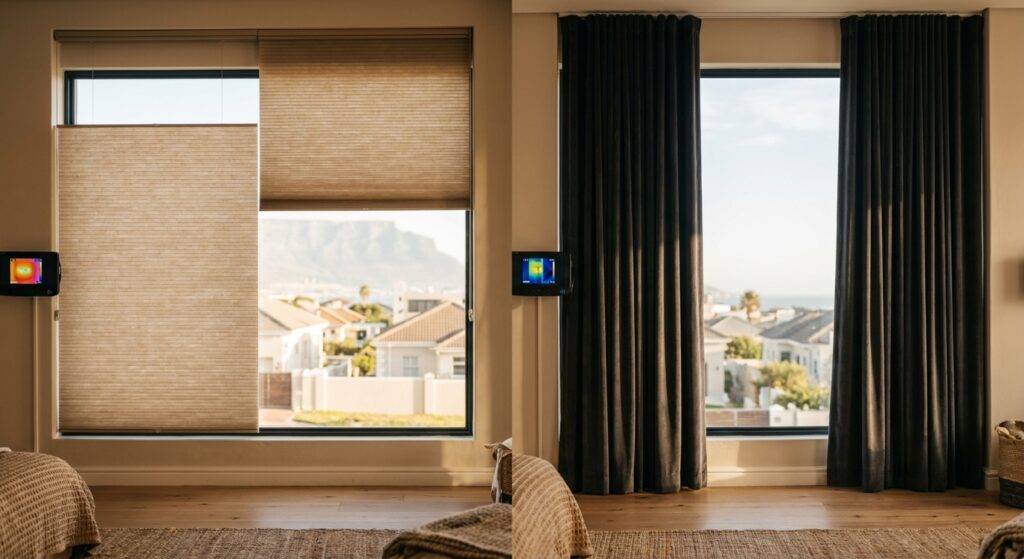
Honeycomb cellular blinds are the most effective single product for window insulation. Heavy, thermal-lined curtains are also highly effective, especially when installed correctly to stop drafts. The answer depends on your specific window type and the problem you need to solve: blocking drafts from old frames or preventing heat transfer through the glass itself. For Cape Town’s climate, which demands both winter heat retention and summer heat rejection, the technical design of the window covering is what matters most.
The Mechanics of Window Insulation
Heat moves through windows in three ways: conduction, convection, and radiation. A window covering’s job is to create a barrier that slows this transfer. The most effective method is creating a pocket of still, trapped air, as air is a very poor conductor of heat. This insulating performance is measured by an R-value; a higher R-value means better insulation.
Key performance factors include:
- Trapped Air: The core principle of insulation. The more effectively a covering traps a layer of air, the better it insulates.
- Fit and Coverage: Gaps around the edges of a blind or curtain allow for air circulation, creating drafts that undermine insulation.
- Material Properties: Fabric density, thermal linings, and reflective backings all contribute to slowing heat transfer.
A well-fitted product that creates a sealed air gap will always outperform a poorly-fitted one, regardless of the material.
Technical Deep-Dive: Cellular Blinds
Cellular blinds, also known as honeycomb blinds, are engineered specifically for insulation. Their unique structure directly addresses the principle of trapped air, making them exceptionally efficient. They outperform nearly all other blind types and even many curtains in pure thermal resistance.
Honeycomb Structure
The hexagonal cells trap air, creating an insulating barrier directly against the window glass. This design can reduce heat loss in winter by up to 40% and block solar heat gain in summer by up to 60%, making it ideal for the Cape Town climate. Double-cell designs provide even more insulation by creating additional air pockets.
Technical Deep-Dive: Thermal Curtains
Heavy curtains with a dedicated thermal lining provide a strong insulating barrier. Their effectiveness relies less on engineered air pockets and more on the thickness of the material and achieving a complete seal around the window frame. For older, drafty windows common in some Cape Town homes, curtains can be a superior solution for blocking active air leaks.
Critical installation factors for curtain insulation include:
- Floor-to-Ceiling Coverage: Curtains must be long and wide enough to cover the entire frame, minimising gaps.
- Pelmets and Cornices: Boxing in the top of the curtain traps hot air, preventing it from circulating down behind the curtain as it cools against the glass.
- Returns: Ensuring the curtain fabric hooks back to the wall on the sides stops drafts from the edges.
Without these measures, a ‘reverse chimney effect’ can occur, where warm room air is drawn down behind the curtain, cooled by the window, and then expelled into the room as a draft.
Precision Solutions with Blinds & Curtain Lane
The best solution depends entirely on your window structure and specific needs. We analyse the thermal dynamics of your space to recommend a system that provides measurable results, whether it’s the engineered efficiency of a cellular blind or the draft-stopping power of a correctly-installed thermal curtain. Get a precise quote based on a professional assessment of your home.
FAQs
What has a better R-value, cellular blinds or thermal curtains?
High-quality cellular shades typically have a higher R-value, ranging from 3.25 to 5.0, compared to conventional curtains which are around R-1. However, thick thermal curtains with linings can achieve an R-value as high as R-6, but their real-world performance depends heavily on preventing air leakage around the edges.
Which is better for blocking summer heat in Cape Town?
Both can be effective. Highly reflective blinds can reduce solar heat gain by around 45%. Light-coloured curtains with a white plastic backing can reduce heat gain by up to 33%. Cellular blinds are particularly effective, capable of reducing unwanted solar heat by up to 60%.
Do blinds cause condensation?
No, blinds do not cause condensation. However, by creating a very effective insulating barrier, they can trap warm, moist indoor air against the cold surface of the window pane, which can lead to condensation forming on the glass. Most honeycomb blinds use polyester, which does not absorb moisture or support mould growth.
Can I use both blinds and curtains?
Yes, layering a cellular blind close to the window with a heavy curtain over it provides the best possible insulation. This combination traps multiple layers of air and effectively stops both heat transfer through the glass and drafts around the frame.