
How to Measure Windows for Blinds: A Complete South African Guide
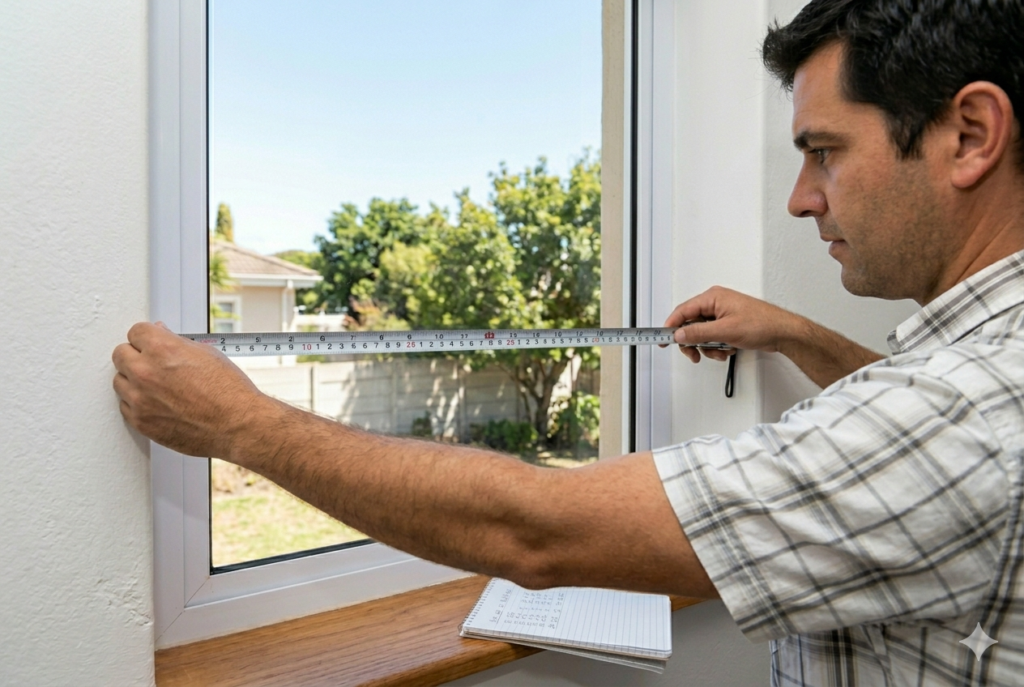
Correctly measuring new blinds requires precision; a few millimetres is the difference between a clean fit and a failed installation. The process begins with deciding between an inside or outside mount and using the right tools for the job.
You must take multiple measurements because South African window frames are rarely perfectly square due to wall settling. The final dimensions depend entirely on the mounting choice and any obstructions present.
Essential Tools You Need Before You Start
Accurate measurement is impossible without the correct equipment. Rushing this stage with improper tools is the most frequent cause of ill-fitting blinds, wasting both time and money. Before you begin, ensure you have the necessary hardware to get precise reading.
A steel tape measure is non-negotiable for accuracy, as fabric or plastic tapes can stretch and give incorrect readings. A sturdy stepladder ensures you can safely and comfortably reach the top of the window frame. Finally, a pencil and paper are needed to record measurements clearly, noting which is the width and which is the height to avoid mix-ups.
Recess Fit vs. Face Fix: Which Installation Method is Best?
Evaluate the following two installation methods to determine the correct approach for your space:
- Recess Fit (Inside Mount): This method offers a clean, integrated appearance by mounting the blind neatly inside the window opening.
- Face Fit (Outside Mount): This approach involves mounting the blind on the wall above and around the frame, making it ideal for shallow windows or maximizing light blockage.
Accurately assessing your window architecture and taking precise measurements will guarantee a flawless installation that maximizes both privacy and light control.
Measurement Guide for Different Blind Types
For both roller and venetian blinds, the three-point measurement system is critical. For a recess fit, always provide the narrowest width and shortest height. Be aware that for roller blinds, the actual fabric width will be approximately 30-38mm less than the total bracket-to-bracket width you provide, to accommodate the control mechanism. For venetian blinds, ensure there is enough recess depth (around 80mm) to prevent the slats from protruding when tilted.
Vertical blinds have different depth requirements based on the slat size. A 90mm slat needs a recess depth of at least 70mm, while a 127mm slat needs a minimum of 90mm. For a recess fit, measure the width only at the top of the opening where the track will be installed.
Common Mistakes to Avoid When Measuring Your Windows
Be sure to avoid these frequent measurement errors when prepping your window order:
- Using a Fabric Tape Measure: Relying on flexible fabric or plastic tapes can lead to inaccurate dimensions because these materials stretch over time. Always use a steel tape measure for precise results.
- Mixing Up Width and Height: Swapping the dimensions on your order form can result in a blind that fits incorrectly.
- Measuring Only Once: Taking a single measurement overlooks the fact that most window frames are not perfectly square. Failing to measure at three different points for both width and height can cause the blind to catch or jam.
- Forgetting Obstructions: Neglecting to check for protruding window handles, tiles, or security fixtures can prevent the blind from lowering completely
Taking the time to double-check your work and follow a strict measurement procedure guarantees your custom blinds will fit perfectly right out of the box.
Ordering Custom Blinds vs. Ready-Made Blinds in South Africa
Ready-made blinds are designed for “standard” window sizes, but these are not consistent across South African homes. While there are common sizes for aluminium windows (e.g., 900mm x 1200mm for bedrooms), variations in plastering and framing mean a standard blind rarely fits perfectly.
Custom-made blinds are manufactured to your exact measurements, ensuring a precise fit for either recess or face fix applications. This eliminates unsightly gaps and operational issues common with off-the-shelf products.
Get a Professional Quote
Incorrect measurements lead to wasted money and blinds that do not fit. Our technicians are equipped to handle any window, including those with burglar bars, deep recesses, or other obstructions. Ensure a perfect fit the first time by having an expert measure for you. Click the button below to get a professional quote based on precise and guaranteed measurements.
FAQs
Should I measure my windows in centimetres or millimetres?
Always measure in millimetres (mm) for the greatest accuracy. Blind manufacturers work in millimetres, and providing your measurements in this unit prevents conversion errors.
Do I need to subtract any width for a recess fit, or does the manufacturer do it?
You should provide the exact, tightest measurement of your window recess. Do not make any deductions yourself. The factory will subtract a small amount (usually 10mm total from the width) to ensure the blind has adequate clearance to operate smoothly within the opening.
What should I do if my window frame is not perfectly square?
This is a very common issue. It is why you must measure the width and height at three different points. For an inside mount (recess fit), use the smallest width and smallest height measurement to ensure the blind fits into the opening at its narrowest point.